



Trusted editorial content reviewed by leading industry experts and experienced editors. Ad Disclosure
Bitcoin has slipped below $70,000, a move that reflects growing selling pressure and market anxiety. The breach of this psychological threshold has increased volatility as short-term participants react quickly to bearish momentum. Analysts note that the present environment is driven less by macroeconomic headlines and more by internal market structure, particularly the behavior of long-term holders.
According to On-chain Mind's findings, Bitcoin price alone rarely defines a market bottom. Instead, the important thing signal tends to come back from holder behavior – particularly whether long-term investors are showing signs of stress. Historically, these participants are the least responsive cohort and sometimes absorb volatility relatively than amplify it through quick selling.
However, when long-term holders suffer widespread unrealized losses, the dynamic changes. Such conditions have often coincided with the late stages of bear markets, when conviction weakens and broader capitulation becomes possible. This phase doesn’t guarantee a direct turnaround, nevertheless it often signals that structural exhaustion is developing.
The risk of long-term holders remains to be below historical capitulation levels
On-Chain Mind also emphasizes that long-term holder risk has historically played a vital role in identifying late-stage bear market conditions. Previous cycles show significant spikes on this metric: about 95% in 2015, about 83% in 2019, nearly 70% in the course of the COVID crash, and about 85% within the 2022 downturn. These spikes typically reflected widespread unrealized losses amongst long-term investors and signaled deep structural tensions across the network.
Bitcoin LTH risk metric | Source: On-chain Mind
Historically, once this indicator rises above the 55-60% range, the bottoming process tends to speed up. At this level, even probably the most patient patients experience significant pressure, often coinciding with the ultimate stages of give up. This will not be necessarily the precise bottom of the value, nevertheless it often precedes stabilization and an eventual recovery.
However, the figure is currently closer to 37%, well below previous capitulation thresholds. This suggests that while market stress is obvious, conditions may not yet reflect the complete exhaustion that typically accompanies sustained cycle lows. If the pattern of diminishing peaks continues, a move into the 70% region would suggest that even strong hands are under significant pressure – historically a prerequisite for a more structural and lasting market bottom.
Bitcoin breaks key weekly support levels as downtrend accelerates
Bitcoin’s weekly structure shows a big deterioration in momentum following rejection from the $120,000-$125,000 area, with the value now trading near the $69,000 zone. The recent collapse pushed Bitcoin well below the 50-week moving average (blue) and 100-week moving average (green), levels that had previously acted as dynamic support in the course of the previous uptrend. The lack of each signals signals a transition from a corrective pullback to a more structural downtrend phase.
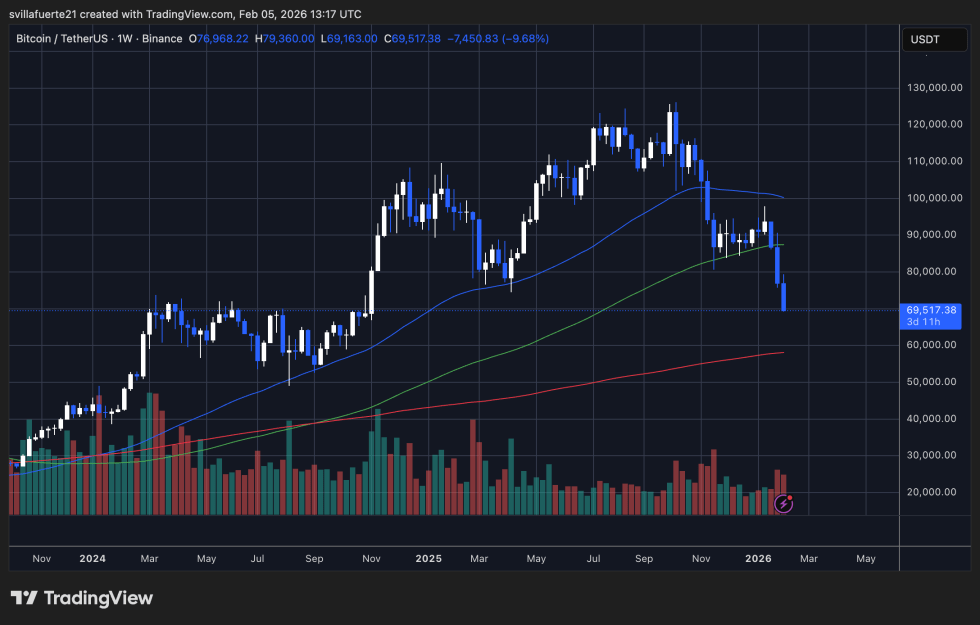 BTC Consolidates Around Key Level | Source: BTCUSDt chart on TradingView
The 200-week moving average (red) stays well below the present price, suggesting that the general macro trend will not be yet in deep bear market territory. However, the speed of the decline and the extension of the bearish candles suggest an aggressive distribution relatively than an orderly consolidation. The volume spikes accompanying the recent downward moves support the interpretation of forced selling and liquidation activity.
From a technical perspective, the $70,000 area has moved from support to resistance after the breakdown. Failure to quickly regain this level would increase the likelihood of further downside exploration, perhaps towards historical demand zones within the low $60,000s. Conversely, stabilization above this region as sales volume declines could indicate seller exhaustion.
Featured image from ChatGPT, chart from TradingView.com
Editorial process At Bitcoinist, the main target is on providing thoroughly researched, accurate, and unbiased content. We maintain strict sourcing standards and each page is rigorously reviewed by our team of top technology experts and experienced editors. This process ensures the integrity, relevance and value of our content to our readers.


